galata
Flight dynamics, control-law design and simulation — reproducibly, from a file you can read, with every number traceable to the routine that produced it.
Today it takes a nonlinear aircraft model, trims it, linearises about that trim, and produces a labelled modal table — short period, phugoid, Dutch roll, roll subsidence and spiral, identified by eigenvector participation rather than by frequency. From non-dimensional derivatives and geometry alone, it reproduces NASA CR-2144's published dimensional derivatives to 0.26% and its published modes to 1.0%.
It evaluates frequency response and reports all four margin types — gain, phase, delay and disk — with every crossover and the frequency at which it occurs, gated against closed-form transfer functions and a published worked example. For multivariable loops it computes principal gains and the sensitivity peaks M_S and M_T, which is what catches a design whose per-channel margins look comfortable and whose loop is not.
Control synthesis and the nonlinear simulation loop are the point of the project and are not built yet. The status table below is the authority on what exists; the roadmap is the authority on what is intended.
C++20 core, strict SI units, deterministic by policy, Apache-2.0.


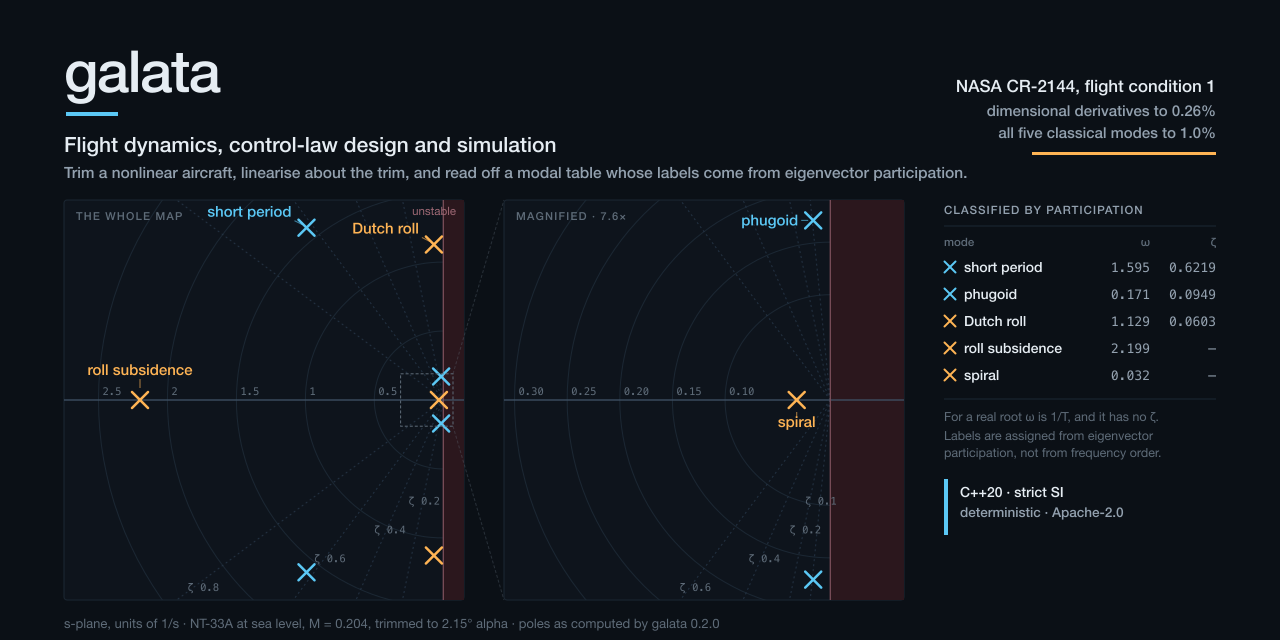
Drawn from a run, not by hand: tools/social/ emits the poles, CI diffs
them, and the labels are the classifier's own output.
The claim, and how to check it in one command
Everything below is produced by
tests/validation/ and regenerated into
docs/VERIFICATION.md, which CI diffs. The input is a
set of non-dimensional derivatives and some geometry — there is no matrix
anywhere in it.
The aircraft. NT-33A, a variable-stability T-33. The condition. Flight condition 1 of eight, Table II-2: sea level, M = 0.204, power approach, bare airframe. The reference. Robert K. Heffley and Wayne F. Jewell, Aircraft Handling Qualities Data, NASA CR-2144, Systems Technology Inc., December 1972. NTRS 19730003312, distribution unlimited.
Dimensional derivatives, against Table II-7
Seven numbers the report computed from the same non-dimensional set by a different route.
| Derivative | galata | published | deviation |
|---|---|---|---|
| Y_v | −0.124902 | −0.125 | 0.08% |
| L_beta' | −5.49695 | −5.49 | 0.13% |
| N_beta' | +0.667796 | +0.667 | 0.12% |
| L_p' | −2.03530 | −2.03 | 0.26% |
| N_p' | −0.115922 | −0.116 | 0.07% |
| L_r' | +0.64184 | +0.641 | 0.13% |
| N_r' | −0.207034 | −0.207 | 0.02% |
The source prints its inputs and outputs to three significant figures, so each value carries up to about 0.5% of its own rounding and several combine in every one of these. The gate is 0.5%. The worst observed is 0.26%.
All five classical modes, against Tables II-4 and II-8
| Mode | galata | published | deviation |
|---|---|---|---|
| Phugoid | ζ 0.094852, ωₙ 0.1714 | 0.0948, 0.172 | 0.05%, 0.35% |
| Short period | ζ 0.62193, ωₙ 1.5950 | 0.622, 1.59 | 0.01%, 0.32% |
| Dutch roll | ζ 0.060259, ωₙ 1.1293 | 0.0609, 1.13 | 1.05%, 0.06% |
| Roll subsidence | 1/T 2.1992 | 2.20 | 0.04% |
| Spiral | 1/T 0.031902 | 0.0318 | 0.32% |
The report prints no headings saying "short period" or "Dutch roll" — the modal characteristics are the factored denominators of its transfer-function tables, and Appendix A prints this exact condition's lateral denominator as its worked example. galata's labels come from eigenvector participation and are checked against that identification.
Reproduce both tables
git clone https://github.com/celikgo/galata.git
cd galata
export VCPKG_ROOT=/path/to/vcpkg          # manifest mode fetches the rest

cmake --preset dev
cmake --build --preset dev

ctest --preset dev -L validation          # fails if any deviation above exceeds its gate
./build/dev/src/cli/galata run examples/nt33a-trim-and-linearise/study.yaml
The tier carries the ctest label validation, so -L is the flag.
Or look at the whole case on one page
The NT-33A at flight condition 1
— trim point, the labelled modal table with its participation factors, the pole map, the Bode
plot with every crossover marked, and a Nyquist against the disk the loop must avoid. One
self-contained page, no JavaScript and no network requests, with a light variant that is also
what it prints as. The committed copy is
docs/reports/nt33a-fc1.html, and it opens from disk.
Every number and every mark on it comes from a run: tools/report/ emits the run record,
scripts/gen-report-page.py draws the page from it, and CI compares the record numerically
against the code and the page byte for byte against the record. The page names the routine that
produced each figure.
What does NOT reproduce
One published quantity does not, and it stays published rather than being
quietly dropped: a state matrix assembled by hand from the report's
dimensional derivatives gives a phugoid damping ratio 2.04% below the
published value, while the full chain above reproduces it to 0.05%. The cause is
now localised to a single matrix entry — a gravity term that the substituted-ẇ
form of the report's Appendix C manufactures and that cannot physically exist.
The investigation, including what was ruled out, is in
docs/notes/phugoid-damping.md; a labelled
regression lock holds the gap at its measured size meanwhile.
Status: 0.2.0 — trim, linearise, analyse
v0.1 was the spine: trim, linearise, and a classified modal table, validated against a published NASA report and driven from a YAML file by a CLI. v0.2 adds the frequency-domain tier on top of it — frequency response, all four margin types, the sensitivity peaks M_S and M_T, and principal gains for multivariable loops — each gated against a closed-form transfer function or a published worked example.
The charter requires that CI exist before the first feature and that no capability be documented before it works, so the gates were built first and the physics landed against them. What exists today:
| Surface | State |
|---|---|
| Build system (CMake + vcpkg, four platform/compiler combinations) | working |
| CI: format, build, test, version consistency, SI boundary, doc links | working |
| Version single-source-of-truth, with provenance in the build identification | working |
| ADRs 0001–0007: ABI relationship, conventions, units, determinism, versioning, EOM reference point, reference-value rights | written |
| Frames, quaternions, state vector, unit boundary (ADR-0002, ADR-0003) | implemented, property-tested |
| U.S. Standard Atmosphere 1976, −5000 m to 86 km | implemented and validated against the published tables |
| Fixed-step RK4, with Richardson step-size study | implemented, order verified against closed-form solutions |
| Nonlinear 6-DOF rigid body, general inertia tensor | implemented and validated against closed-form solutions of Euler's equations |
YAML pipeline runner and the galata CLI |
working |
| Runnable examples, executed by the test suite | working (five, four of them executed end to end) |
| Determinism: bit-identical repeat runs, cross-platform bound measured | working |
| Nonlinear aircraft model from a derivative buildup | implemented and validated |
trim.level — Newton on a square residual, fixed iteration count |
implemented and validated |
linearize.finitediff — central differences with Richardson error estimates |
implemented and validated |
| Frequency response, gain/phase/delay/disk margins, M_S and M_T, principal gains | implemented and validated |
| Everything else in §"What it will do" below | not built |
The table above is maintained by hand and checked in review. The capability
table below is not: it is generated from the registry the CLI dispatches
through, by scripts/gen-status-table.sh, and CI fails if the committed copy
disagrees. Run galata capabilities to get the same list from your own build.
Capabilities in this build
| Capability | What it does | Produces | State |
|---|---|---|---|
analyze.diskmargin |
Disk margin of one loop — robustness to simultaneous gain and phase variation — with the guaranteed gain and phase range and a destabilising perturbation on the boundary | disk_margin |
implemented and validated |
analyze.freqresp |
Frequency response of one loop of a linear model, evaluated by Hessenberg solves with the grid refined around the system's own lightly damped modes | frequency_response |
implemented and validated |
analyze.margins |
Gain, phase and delay margins of one loop, with every crossover reported and the frequency at which each occurs | stability_margins |
implemented and validated |
analyze.modes |
Eigenvalues, modal metrics and participation factors, with the classical aircraft modes classified by participation | modal_table |
implemented and validated |
analyze.sensitivity |
Sensitivity and complementary sensitivity peaks M_S and M_T of a loop closed with negative unit feedback, and the frequencies at which they occur | sensitivity_peaks |
implemented and validated |
analyze.sigma |
Singular values of a MIMO transfer matrix over frequency — the principal gains, their spread, and the peak gain | singular_values |
implemented and validated |
linearize.finitediff |
Linearise about a trim point by central differences, with a Richardson truncation-error estimate per entry | linear_system |
implemented and validated |
model.aircraft.derivatives |
Load a nonlinear aircraft model built from a non-dimensional derivative set | aircraft |
implemented and validated |
model.linear.statespace |
Load a linear state-space model (A, B, state and input names) from a YAML file | linear_system |
implemented, unvalidated |
report.markdown |
Write a Markdown report from upstream results | report |
implemented, unvalidated |
trim.level |
Solve straight-line trim — wings level, no sideslip — for angle of attack, elevator and thrust, by Newton on a square residual | trim_point |
implemented and validated |
implemented and validated means the output has been compared against a
published reference; see docs/VERIFICATION.md.
implemented, unvalidated means it works and is tested, but no published
reference has been compared against.
What this is NOT
- Not a certified tool. Nothing here is DO-178C qualified. It must never be used as evidence in a certification package.
- Not a MATLAB replacement. It covers one workflow well, not a general numerical platform.
- Not a flight simulator. No scenery, no weather rendering, no cockpit, no X-Plane rivalry. The 3-D view is an engineering visualisation, not entertainment.
- Not a CFD or panel code. Aerodynamics come from tabulated or polynomial coefficient models supplied by the user or shipped as cited reference data. The tool never computes aerodynamic coefficients from geometry.
- Not an autopilot. It designs and analyses control laws and can export them; it does not fly real aircraft and ships no airworthy code.
Who it is for
Flight control engineers, GNC engineers, controls graduate students and UAV autopilot developers — people who currently reach for MATLAB, Simulink, Control System Toolbox and Aerospace Blockset to go from trim to linearisation to synthesis to analysis to nonlinear verification.
Quickstart
Sixty seconds, and it works today. It builds the library, runs the test suite, and then runs a real study.
git clone https://github.com/celikgo/galata.git
cd galata

# vcpkg in manifest mode fetches Eigen, fmt, yaml-cpp and GoogleTest.
export VCPKG_ROOT=/path/to/vcpkg

cmake --preset dev
cmake --build --preset dev
ctest --preset dev

# Then run the shipped study: it trims a nonlinear NT-33A, linearises it,
# and reports all five classical modes — every number checked against a
# published NASA report.
./build/dev/src/cli/galata run examples/nt33a-trim-and-linearise/study.yaml
That writes trim-and-modes.md next to the study: the trim with its residual
and Jacobian conditioning, the state matrices, and the modal tables with the
participation factors the labelling rests on. See
examples/nt33a-trim-and-linearise/.
galata capabilities lists what your build can do and how far each capability
has been checked.
Requires CMake 3.24+, Ninja, a C++20 compiler and a vcpkg checkout. Tested on
Linux (GCC and Clang), macOS (AppleClang) and Windows (MSVC) — see
.github/workflows/ci.yml for the exact matrix.
What it will do
This section describes the intended product. Nothing named here is
implemented — the two capabilities that used to be listed as intentions,
modal classification by eigenvector participation and the four margin types,
have been built and have moved up into the Status table. This section is kept
so that the decisions recorded in docs/adr/ have a stated purpose. The Status
table above is what actually works.
The workflow is trim → linearise → analyse → synthesise → verify, expressed as a YAML pipeline that the CLI and (later) the desktop application both execute, so that a study is a file rather than a sequence of clicks. Still to come: a nonlinear 6-DOF simulation with actuator rate limits in the loop, MIL-STD-1797A handling-qualities assessment, LQR and Riccati synthesis, a stable C plugin ABI for user-supplied aerodynamic and sensor models, and an AI layer that composes and runs these pipelines without ever producing a number itself.
Milestones and their contents are in docs/ROADMAP.md.
Engineering rules
These are gates, not aspirations. A change that violates one does not merge.
- CI exists before the feature. There is no commit that adds source without adding to the CI graph.
- Nothing is documented before it works. A capability that is a stub says so in its own output and in the docs. A documentation claim that CI does not verify is a bug, and the Status table above is the contract.
- One source of version truth — the
VERSIONfile, checked byscripts/check-version-consistency.sh. - Every URL in every document resolves, checked by
scripts/check-doc-links.sh. - Strict SI in the numerical core — metres, seconds, kilograms, newtons,
radians, kelvin, pascals. Degrees, feet and knots exist only at the UI and
file-format boundary, converted by one documented set of functions and
enforced by
scripts/check-si-boundary.sh. See ADR-0003. - Determinism is tested, and its limits are published. Same platform: bit
identical. Across platforms: agreement to a published bound, because
platform math libraries do not agree on
sinin the last bits and claiming otherwise would be false. See ADR-0004. - Every physics and numerics source file cites its literature source and states the model's validity envelope and the direction and magnitude of its known error.
- Reference values in tests come from published sources, never from the
implementation. See
docs/TESTING.md. - No number reaches the user without provenance — which capability produced it, from what inputs, at what version.
Conventions
Getting these wrong is how flight software fails silently, so they are written down once, in full, in ADR-0002:
- NED navigation frame, FRD body frame.
- Attitude as a unit quaternion, Hamilton convention, scalar-first
[w, x, y, z], representing the body-to-NED rotation. Euler angles (3-2-1) are derived output, never integrated state. - Thirteen-component state vector
[p_n p_e p_d, u v w, q_w q_x q_y q_z, p q r]in that order — the order it is integrated, fingerprinted and serialised in. It is not the row order of a produced state-space matrix: linearisation works in twelve Euler coordinates and reports a reduced set, and everyLinearSystemcarries its own state names. - Full 6-DOF equations of motion with a general inertia tensor —
I_xzis not assumed zero.
Documentation
Everything below is also readable at celikgo.github.io/galata, which is this repository's own Markdown rendered — including the generated V&V report. It adds no content that is not in the repository.
docs/CHARTER.md— the engineering rules, in fulldocs/adr/— architecture decision recordsdocs/VERIFICATION.md— the V&V report: what has been checked against a published document, the agreement measured, and what is explicitly unvalidated. Generated by CI from the code, not written by hand.docs/TESTING.md— the test tiers and what each provesdocs/ROADMAP.md— milestones and their contentsdocs/rfc/— designs proposed but not built, each one written around how it would be verified. RFC-0001 is control synthesis.- The NT-33A flight-condition report
— the trim point, the modal table, the pole map and the margins for the reference case, drawn
from a run and diffed by CI. Committed at
docs/reports/nt33a-fc1.html. CLAUDE.mdand.claude/skills/— the build, the gates, and the verification methodology written down as skillsCONTRIBUTING.md— building, the pre-push gates, what review asksSECURITY.md— the threat model this tool actually has, and how to report a vulnerability privatelyCODE_OF_CONDUCT.md— Contributor Covenant 2.1
Checking the validation claim yourself
The agreement with NASA CR-2144 quoted at the top of this file is not a sentence somebody typed. It is gated:
- the reference values live in
tests/validation/reference/nt33a_fc1.csv, which carries the report number, its authors, its rights position, the SHA-256 of the scan the numbers were read from, and the method by which they were transcribed; tests/validation/test_nt33a_trim_linearize.cppruns the whole chain from the non-dimensional derivative set and fails if any dimensional derivative deviates by more than 0.5%;tests/validation/test_nt33a_modes.cppdoes the same for the five classical modes;docs/VERIFICATION.mdis regenerated from those runs byscripts/gen-verification.sh, and CI fails if the committed copy has drifted, so the report cannot describe a measurement the code no longer produces.
ctest --preset dev -L validation # the whole validation tier
The tier carries the ctest label validation, so -L is the flag; the
tests are named after what they check, not after the tier.
Licence
Apache-2.0. See LICENSE and NOTICE.
The name is the Galata Tower in Istanbul, from which — by an account first printed in Evliya Çelebi's Seyahatnâme — Hezârfen Ahmed Çelebi is said to have glided across the Bosphorus in the 1630s. The story is not evidence and this project does not treat it as such; it is just where the name comes from.